
Growing Paulownia in Australia: Site, Spacing, Pruning and Yield
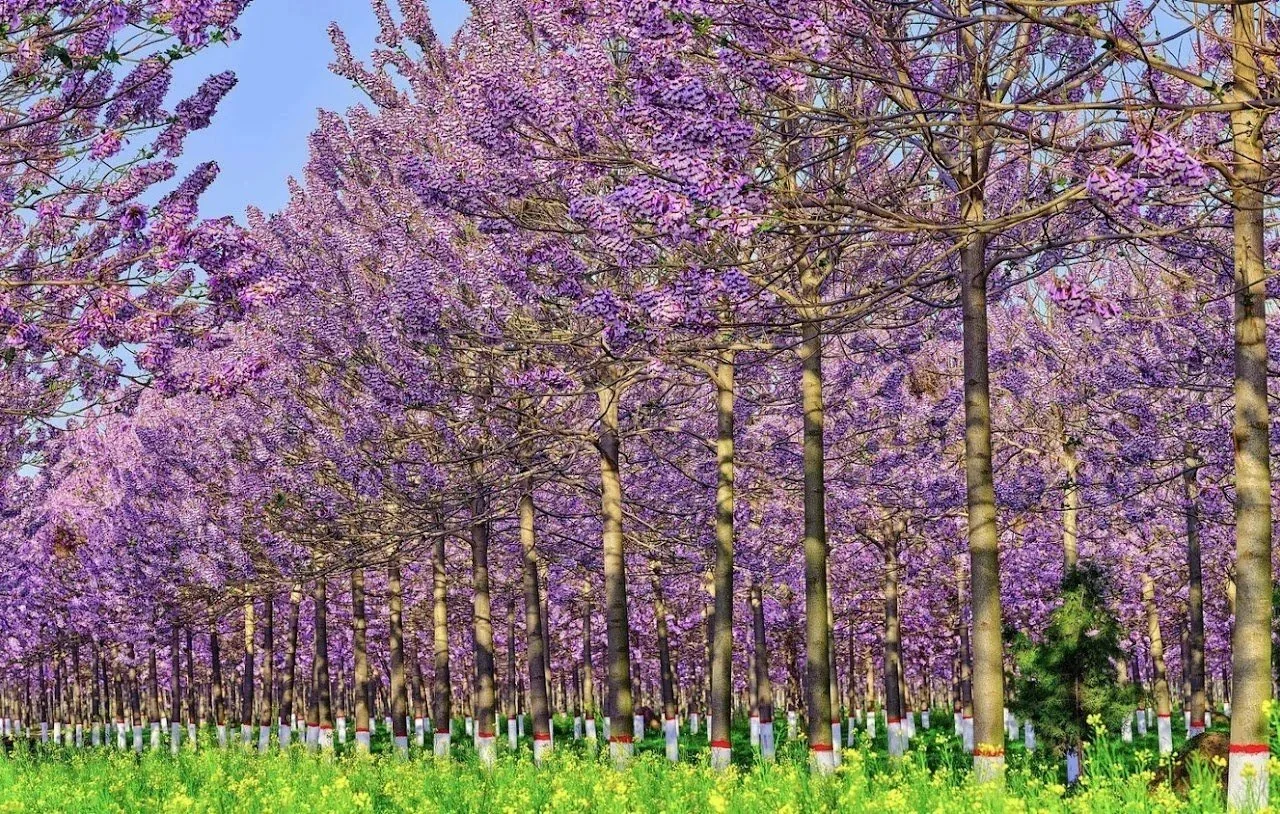
A Paulownia plantation in full flower in spring.
By Alastair Pilley, BEnv (Environmental Science), Paulownia Timber Supplies Australia.
Paulownia (also called Kiri or the empress tree) is often described as a miracle tree: it can grow several metres in a single season and produces one of the lightest, most stable timbers in the world. Those claims are partly true. This article summarises what the published research says about growing Paulownia in Australia for timber, including site requirements, spacing, pruning, realistic yields and weed risk, so you can decide whether it suits your land. For diagrams, data and full references, download our free 10-page growing guide and one-page grower guides.
The short answer: is growing Paulownia worth it?
Paulownia can grow remarkably fast, but high-quality timber only comes from well-sited, intensively managed trees, and much of the volume in a standing tree is lost between the log and the finished board. In an Australian sawing study of well-formed 10-year-old logs, only about 38% of the log volume ended up as dried, graded and dressed timber (Beel et al., 2005). Unmanaged trees do far worse: in a nine-year US trial of unmanaged Paulownia, only 27% of trees survived (Berg et al., 2020).
What Paulownia needs to grow well
Warm summers: at least three months with mean monthly temperatures above 17 °C (Barton et al., 2007).
Water in the growing season: about 100 mm a month in the first year and at least about 50 mm a month after that, from rain or irrigation. Young trees can use 1,000 to 2,000 litres each in their first season (Barton et al., 2007; Jakubowski, 2022). Much of southern Australia gets its rain in winter, so most plantings need irrigation.
Deep, free-draining soil: avoid heavy clay, winter waterlogging, a shallow water table and salinity (Barton et al., 2007).
Shelter and no late frosts: young stems and the huge leaves break in strong wind, and spring frosts kill green shoots. Avoid frost hollows (Barton et al., 2007; Jakubowski, 2022).
Full sun: Paulownia is very light-demanding, so shaded trees and the inside of dense stands slow down (Criscuoli et al., 2022).
Four to five years of hands-on care: weed control, watering and form pruning to grow a straight, branch-free trunk of 5 to 7 metres (Barton et al., 2007).
In New Zealand, most Paulownia species trials were abandoned within a few years because of frost, drought, poor or heavy soils, or stock damage (Barton et al., 2007). Site selection is the factor most often underestimated.
Spacing: how far apart should you plant Paulownia?
Trees grown for sawlogs need room. Biomass plantings use about 2,000 to 3,300 trees per hectare, but timber plantings use far fewer: about 550 to 750 trees per hectare at establishment, and fewer still at harvest (Jakubowski, 2022). A final spacing of about 200 trees per hectare (for example 7 × 7 m) is recommended for sawlogs (Barton et al., 2007).
Italian research supports wide spacing. In irrigated, carefully pruned hybrid plantations at about 4 × 4 m, annual ring width fell from about 33 mm a year in years 1 and 2 to under 7 mm by year 6 as the crowns met, and edge trees with more light were about 30% larger in diameter than interior trees (Criscuoli et al., 2022).
Establishing young Paulownia trees
Ground preparation: rip heavy soils to at least 80 cm, and plant on mounds about 30 cm high on flat or poorly drained land.
Planting time: late winter to early spring, after frost risk has passed.
Weed control: keep a 1.5 m circle around each tree weed-free for at least two growing seasons. In a New Zealand trial, weed control mattered more than fertiliser.
Protection: fence out stock, shelter young trees from wind, and keep mulch and herbicide spray off the stem.
(Barton et al., 2007; García-Morote et al., 2014.)
Pruning Paulownia for clear timber
Left alone, Paulownia forms a short trunk under a wide, low, branchy crown. A timber tree needs a straight, branch-free trunk of at least 5 to 7 metres, so most of its value is created by the grower's pruning (Barton et al., 2007). Many growers cut the stem back to ground level after the first season and keep only the strongest regrowth shoot, then lift the crown in stages over the next few years, never removing more than half the green crown at once. Large pruning wounds and sunscald give rot fungi a way in (Bayliss et al., 2007). Well-pruned Italian hybrid trees produced logs with no knots in the pruned zone, but only when pruning was done early and on time (Criscuoli et al., 2022).
Paulownia weed risk in Australia
Paulownia tomentosa is regarded as an emerging environmental weed in Queensland and New South Wales (Weeds of Australia, n.d.). Sterile hybrids lower the risk but do not remove it: in a Slovakian study, two hybrid clones produced no viable seed but still spread by root suckers (Pauková & Hauptvogl, 2026). Before you buy trees, ask the nursery for the exact clone and evidence of sterility, check local rules with your council, and avoid planting near creeks and bushland.
Pests and diseases of Paulownia in Australia
Paulownia has few serious pests in its native range, but Australian plantations have recorded a phytoplasma disease, Alternaria leaf blight, wood rot entering through pruning wounds and sunscald, and root-knot nematodes (Bayliss et al., 2005, 2007; Perera et al., 2005; Pleysier et al., 2006).
How fast does Paulownia grow, and what is the yield?
Early height growth is spectacular: Italian hybrids reached 5 m in their second season (Criscuoli et al., 2022). On good New Zealand sites, trees reached about 30 to 38 cm in diameter at 5 years (Barton et al., 2007). But fast early growth is not the same as a harvestable crop. Wood from very young trees is mostly juvenile wood, so for sawn timber plan on a rotation of well over a decade, not the 5 to 7 years sometimes promoted (Fos et al., 2023).
Even good logs lose a lot of volume on the way to a finished board. Paulownia has a hollow pith, a low density (about 260 kg/m³ air-dry) and sap stain if logs are not processed promptly, and only 38% of the log in the Australian study became dried, graded and dressed boards (Beel et al., 2005; Criscuoli et al., 2022). The result is excellent timber for linings, boards, cores, surfboards and craft, but not structural timber. See our technical overview of Paulownia wood properties.
Will you harvest my Paulownia trees?
We are often asked this. Most trees we are offered were never form-pruned, so they have short or forked trunks, large knots, hidden decay or wind damage. Even good logs return less than 40% as finished timber, and felling, extracting, carting and milling scattered trees is very labour-intensive. The market adds to this: in Australia, demand is strongest for wide, thick boards and large sections, which can only be cut from big, straight, clear logs, so their yield is even lower. Small sections are worth considerably less per cubic metre, yet they take just as much labour to stack, dry and handle.
Larger stands. We typically don't harvest standing trees, as we already have our own established supply chains, so we can't commit to buying or harvesting any stand. That said, if you have a larger, well-managed planting, you are welcome to let us know about it with a few details and photos. It helps us keep track of what Paulownia is growing around Australia.
Only a few trees? Use the timber yourself. A local mobile sawmiller can cut logs into boards on site, or, because Paulownia is light and soft, you can mill it yourself with a chainsaw mill. Mill soon after felling to avoid sap stain (Beel et al., 2005), saw around the hollow centre of the log, and stack the boards flat on stickers under cover to dry. Paulownia dries easily and with little shrinkage (Barton et al., 2007). Always wear full chainsaw safety gear, and use a qualified arborist to fell trees near buildings, fences or power lines.
Free Paulownia growing guides to download
Our Downloads page has the full 10-page guide, Growing Paulownia for Timber in Australia, plus eight one-page guides: site suitability, planting and establishment, pruning for clear timber, pests and diseases, weed risk and hybrids, spacing and yield, "will you harvest my trees?" and timber properties and uses.
Want Paulownia timber without growing it?
We supply kiln-dried Paulownia boards, VJ lining boards, thin sheets, surfboard blanks and CNC-machined parts, delivered Australia-wide. Get in touch, email info@paulowniatimber.com.au or call 0426 281 785.
References
Barton, I. L., Nicholas, I. D., & Ecroyd, C. E. (2007). Paulownia (Forest Research Bulletin No. 231). Ensis; New Zealand Forest Research Institute.
Bayliss, K. L., Foster, C., Dell, B., & Hardy, G. E. St J. (2007). Pycnoporus cinnabarinus is pathogenic on living Paulownia trees. Australasian Plant Pathology, 36(1), 53–55. https://doi.org/10.1071/AP06079
Bayliss, K. L., Saqib, M., Dell, B., Jones, M. G. K., & Hardy, G. E. St J. (2005). First record of 'Candidatus Phytoplasma australiense' in Paulownia trees. Australasian Plant Pathology, 34(1), 123–124. https://doi.org/10.1071/AP04089
Beel, M., Davis, S., Murphy, J., & Piper, P. (2005). Product potential of paulownia timber. Australian Forestry, 68(1), 3–8. https://doi.org/10.1080/00049158.2005.10676219
Berg, E. C., Zarnoch, S. J., & McNab, W. H. (2020). Survivorship, attained diameter, height and volume of three Paulownia species after 9 years in the southern Appalachians, USA. Journal of Forestry Research, 31(6), 2181–2191. https://doi.org/10.1007/s11676-019-01021-9
Criscuoli, I., Brunetti, M., & Goli, G. (2022). Characterization of Paulownia elongata x fortunei (BIO 125 clone) roundwood from plantations in Northern Italy. Forests, 13(11), 1841. https://doi.org/10.3390/f13111841
Fos, M., Oliver-Villanueva, J.-V., & Vazquez, M. (2023). Radial variation in anatomical wood characteristics and physical properties of Paulownia elongata x Paulownia fortunei hybrid Cotevisa 2 from fast-growing plantations. European Journal of Wood and Wood Products, 81(4), 819–831. https://doi.org/10.1007/s00107-023-01941-8
García-Morote, F. A., López-Serrano, F. R., Martínez-García, E., Andrés-Abellán, M., Dadi, T., Candel, D., Rubio, E., & Lucas-Borja, M. E. (2014). Stem biomass production of Paulownia elongata × P. fortunei under low irrigation in a semi-arid environment. Forests, 5(10), 2505–2520. https://doi.org/10.3390/f5102505
Jakubowski, M. (2022). Cultivation potential and uses of paulownia wood: A review. Forests, 13(5), 668. https://doi.org/10.3390/f13050668
Pauková, Ž., & Hauptvogl, M. (2026). Global distribution and invasive potential of Arundo donax and Paulownia spp.: A case study in Slovakia. Journal of Central European Agriculture, 27(2), 532–544. https://doi.org/10.5513/JCEA01/27.2.4898
Perera, M. R., Bayliss, K. L., & Jones, M. G. K. (2005). New Australian record for infection of trees in Paulownia plantations by root-knot nematodes. Australasian Plant Pathology, 34(3), 419–420. https://doi.org/10.1071/AP05041
Pleysier, C. E., Bayliss, K. L., Dell, B., & Hardy, G. E. St J. (2006). Temperature, humidity, wounding and leaf age influence the development of Alternaria alternata lesions on leaves of Paulownia fortunei. Australasian Plant Pathology, 35(3), 329–333. https://doi.org/10.1071/AP06030
Weeds of Australia. (n.d.). Paulownia tomentosa. Queensland Government; Lucid. https://keyserver.lucidcentral.org/weeds/data/media/Html/paulownia_tomentosa.htm
This article is general information only and is not financial, legal or agronomic advice. Check weed, planning and plantation rules with your council and state agencies before planting. This is independent work and is not affiliated with or endorsed by any university. Paulownia Timber Supplies Australia is operated by Sine Surf Pty Ltd (ABN 24 655 648 374), Hornsby, NSW.
