
Articles & guides
Paulownia Timber Articles and Guides
Practical, honest information about Paulownia (Kiri) timber: how to grow it, what it is good for, and how to work with it. Written by Alastair Pilley, BEnv (Environmental Science), Paulownia Timber Supplies Australia.
- Growing Paulownia
- Surfboards & handplanes
- Lining boards
- Strip planking
- Guitar bodies
- Cutting boards
- Sustainability
Growing Paulownia in Australia: Site, Spacing, Pruning and Yield
What the research says about growing Paulownia in Australia for timber: site, spacing, pruning, realistic yields, weed risk and whether it suits your land. Free grower guides included.
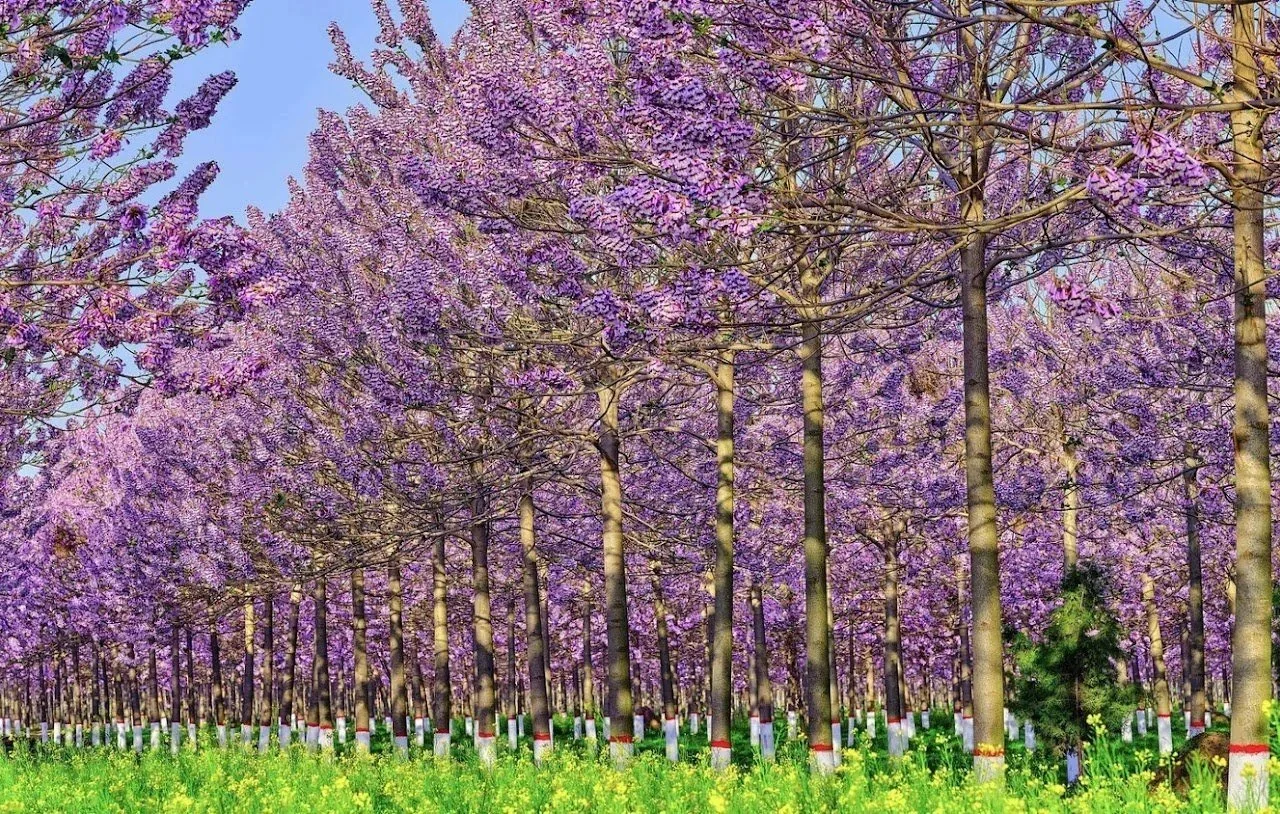
A Paulownia plantation in full flower in spring.
By Alastair Pilley, BEnv (Environmental Science), Paulownia Timber Supplies Australia.
Paulownia (also called Kiri or the empress tree) is often described as a miracle tree: it can grow several metres in a single season and produces one of the lightest, most stable timbers in the world. Those claims are partly true. This article summarises what the published research says about growing Paulownia in Australia for timber, including site requirements, spacing, pruning, realistic yields and weed risk, so you can decide whether it suits your land. For diagrams, data and full references, download our free 10-page growing guide and one-page grower guides.
The short answer: is growing Paulownia worth it?
Paulownia can grow remarkably fast, but high-quality timber only comes from well-sited, intensively managed trees, and much of the volume in a standing tree is lost between the log and the finished board. In an Australian sawing study of well-formed 10-year-old logs, only about 38% of the log volume ended up as dried, graded and dressed timber (Beel et al., 2005). Unmanaged trees do far worse: in a nine-year US trial of unmanaged Paulownia, only 27% of trees survived (Berg et al., 2020).
What Paulownia needs to grow well
Warm summers: at least three months with mean monthly temperatures above 17 °C (Barton et al., 2007).
Water in the growing season: about 100 mm a month in the first year and at least about 50 mm a month after that, from rain or irrigation. Young trees can use 1,000 to 2,000 litres each in their first season (Barton et al., 2007; Jakubowski, 2022). Much of southern Australia gets its rain in winter, so most plantings need irrigation.
Deep, free-draining soil: avoid heavy clay, winter waterlogging, a shallow water table and salinity (Barton et al., 2007).
Shelter and no late frosts: young stems and the huge leaves break in strong wind, and spring frosts kill green shoots. Avoid frost hollows (Barton et al., 2007; Jakubowski, 2022).
Full sun: Paulownia is very light-demanding, so shaded trees and the inside of dense stands slow down (Criscuoli et al., 2022).
Four to five years of hands-on care: weed control, watering and form pruning to grow a straight, branch-free trunk of 5 to 7 metres (Barton et al., 2007).
In New Zealand, most Paulownia species trials were abandoned within a few years because of frost, drought, poor or heavy soils, or stock damage (Barton et al., 2007). Site selection is the factor most often underestimated.
Spacing: how far apart should you plant Paulownia?
Trees grown for sawlogs need room. Biomass plantings use about 2,000 to 3,300 trees per hectare, but timber plantings use far fewer: about 550 to 750 trees per hectare at establishment, and fewer still at harvest (Jakubowski, 2022). A final spacing of about 200 trees per hectare (for example 7 × 7 m) is recommended for sawlogs (Barton et al., 2007).
Italian research supports wide spacing. In irrigated, carefully pruned hybrid plantations at about 4 × 4 m, annual ring width fell from about 33 mm a year in years 1 and 2 to under 7 mm by year 6 as the crowns met, and edge trees with more light were about 30% larger in diameter than interior trees (Criscuoli et al., 2022).
Establishing young Paulownia trees
Ground preparation: rip heavy soils to at least 80 cm, and plant on mounds about 30 cm high on flat or poorly drained land.
Planting time: late winter to early spring, after frost risk has passed.
Weed control: keep a 1.5 m circle around each tree weed-free for at least two growing seasons. In a New Zealand trial, weed control mattered more than fertiliser.
Protection: fence out stock, shelter young trees from wind, and keep mulch and herbicide spray off the stem.
(Barton et al., 2007; García-Morote et al., 2014.)
Pruning Paulownia for clear timber
Left alone, Paulownia forms a short trunk under a wide, low, branchy crown. A timber tree needs a straight, branch-free trunk of at least 5 to 7 metres, so most of its value is created by the grower's pruning (Barton et al., 2007). Many growers cut the stem back to ground level after the first season and keep only the strongest regrowth shoot, then lift the crown in stages over the next few years, never removing more than half the green crown at once. Large pruning wounds and sunscald give rot fungi a way in (Bayliss et al., 2007). Well-pruned Italian hybrid trees produced logs with no knots in the pruned zone, but only when pruning was done early and on time (Criscuoli et al., 2022).
Paulownia weed risk in Australia
Paulownia tomentosa is regarded as an emerging environmental weed in Queensland and New South Wales (Weeds of Australia, n.d.). Sterile hybrids lower the risk but do not remove it: in a Slovakian study, two hybrid clones produced no viable seed but still spread by root suckers (Pauková & Hauptvogl, 2026). Before you buy trees, ask the nursery for the exact clone and evidence of sterility, check local rules with your council, and avoid planting near creeks and bushland.
Pests and diseases of Paulownia in Australia
Paulownia has few serious pests in its native range, but Australian plantations have recorded a phytoplasma disease, Alternaria leaf blight, wood rot entering through pruning wounds and sunscald, and root-knot nematodes (Bayliss et al., 2005, 2007; Perera et al., 2005; Pleysier et al., 2006).
How fast does Paulownia grow, and what is the yield?
Early height growth is spectacular: Italian hybrids reached 5 m in their second season (Criscuoli et al., 2022). On good New Zealand sites, trees reached about 30 to 38 cm in diameter at 5 years (Barton et al., 2007). But fast early growth is not the same as a harvestable crop. Wood from very young trees is mostly juvenile wood, so for sawn timber plan on a rotation of well over a decade, not the 5 to 7 years sometimes promoted (Fos et al., 2023).
Even good logs lose a lot of volume on the way to a finished board. Paulownia has a hollow pith, a low density (about 260 kg/m³ air-dry) and sap stain if logs are not processed promptly, and only 38% of the log in the Australian study became dried, graded and dressed boards (Beel et al., 2005; Criscuoli et al., 2022). The result is excellent timber for linings, boards, cores, surfboards and craft, but not structural timber. See our technical overview of Paulownia wood properties.
Will you harvest my Paulownia trees?
We are often asked this. Most trees we are offered were never form-pruned, so they have short or forked trunks, large knots, hidden decay or wind damage. Even good logs return less than 40% as finished timber, and felling, extracting, carting and milling scattered trees is very labour-intensive. The market adds to this: in Australia, demand is strongest for wide, thick boards and large sections, which can only be cut from big, straight, clear logs, so their yield is even lower. Small sections are worth considerably less per cubic metre, yet they take just as much labour to stack, dry and handle.
Larger stands. We typically don't harvest standing trees, as we already have our own established supply chains, so we can't commit to buying or harvesting any stand. That said, if you have a larger, well-managed planting, you are welcome to let us know about it with a few details and photos. It helps us keep track of what Paulownia is growing around Australia.
Only a few trees? Use the timber yourself. A local mobile sawmiller can cut logs into boards on site, or, because Paulownia is light and soft, you can mill it yourself with a chainsaw mill. Mill soon after felling to avoid sap stain (Beel et al., 2005), saw around the hollow centre of the log, and stack the boards flat on stickers under cover to dry. Paulownia dries easily and with little shrinkage (Barton et al., 2007). Always wear full chainsaw safety gear, and use a qualified arborist to fell trees near buildings, fences or power lines.
Free Paulownia growing guides to download
Our Downloads page has the full 10-page guide, Growing Paulownia for Timber in Australia, plus eight one-page guides: site suitability, planting and establishment, pruning for clear timber, pests and diseases, weed risk and hybrids, spacing and yield, "will you harvest my trees?" and timber properties and uses.
Want Paulownia timber without growing it?
We supply kiln-dried Paulownia boards, VJ lining boards, thin sheets, surfboard blanks and CNC-machined parts, delivered Australia-wide. Get in touch, email info@paulowniatimber.com.au or call 0426 281 785.
References
Barton, I. L., Nicholas, I. D., & Ecroyd, C. E. (2007). Paulownia (Forest Research Bulletin No. 231). Ensis; New Zealand Forest Research Institute.
Bayliss, K. L., Foster, C., Dell, B., & Hardy, G. E. St J. (2007). Pycnoporus cinnabarinus is pathogenic on living Paulownia trees. Australasian Plant Pathology, 36(1), 53–55. https://doi.org/10.1071/AP06079
Bayliss, K. L., Saqib, M., Dell, B., Jones, M. G. K., & Hardy, G. E. St J. (2005). First record of 'Candidatus Phytoplasma australiense' in Paulownia trees. Australasian Plant Pathology, 34(1), 123–124. https://doi.org/10.1071/AP04089
Beel, M., Davis, S., Murphy, J., & Piper, P. (2005). Product potential of paulownia timber. Australian Forestry, 68(1), 3–8. https://doi.org/10.1080/00049158.2005.10676219
Berg, E. C., Zarnoch, S. J., & McNab, W. H. (2020). Survivorship, attained diameter, height and volume of three Paulownia species after 9 years in the southern Appalachians, USA. Journal of Forestry Research, 31(6), 2181–2191. https://doi.org/10.1007/s11676-019-01021-9
Criscuoli, I., Brunetti, M., & Goli, G. (2022). Characterization of Paulownia elongata x fortunei (BIO 125 clone) roundwood from plantations in Northern Italy. Forests, 13(11), 1841. https://doi.org/10.3390/f13111841
Fos, M., Oliver-Villanueva, J.-V., & Vazquez, M. (2023). Radial variation in anatomical wood characteristics and physical properties of Paulownia elongata x Paulownia fortunei hybrid Cotevisa 2 from fast-growing plantations. European Journal of Wood and Wood Products, 81(4), 819–831. https://doi.org/10.1007/s00107-023-01941-8
García-Morote, F. A., López-Serrano, F. R., Martínez-García, E., Andrés-Abellán, M., Dadi, T., Candel, D., Rubio, E., & Lucas-Borja, M. E. (2014). Stem biomass production of Paulownia elongata × P. fortunei under low irrigation in a semi-arid environment. Forests, 5(10), 2505–2520. https://doi.org/10.3390/f5102505
Jakubowski, M. (2022). Cultivation potential and uses of paulownia wood: A review. Forests, 13(5), 668. https://doi.org/10.3390/f13050668
Pauková, Ž., & Hauptvogl, M. (2026). Global distribution and invasive potential of Arundo donax and Paulownia spp.: A case study in Slovakia. Journal of Central European Agriculture, 27(2), 532–544. https://doi.org/10.5513/JCEA01/27.2.4898
Perera, M. R., Bayliss, K. L., & Jones, M. G. K. (2005). New Australian record for infection of trees in Paulownia plantations by root-knot nematodes. Australasian Plant Pathology, 34(3), 419–420. https://doi.org/10.1071/AP05041
Pleysier, C. E., Bayliss, K. L., Dell, B., & Hardy, G. E. St J. (2006). Temperature, humidity, wounding and leaf age influence the development of Alternaria alternata lesions on leaves of Paulownia fortunei. Australasian Plant Pathology, 35(3), 329–333. https://doi.org/10.1071/AP06030
Weeds of Australia. (n.d.). Paulownia tomentosa. Queensland Government; Lucid. https://keyserver.lucidcentral.org/weeds/data/media/Html/paulownia_tomentosa.htm
This article is general information only and is not financial, legal or agronomic advice. Check weed, planning and plantation rules with your council and state agencies before planting. This is independent work and is not affiliated with or endorsed by any university. Paulownia Timber Supplies Australia is operated by Sine Surf Pty Ltd (ABN 24 655 648 374), Hornsby, NSW.
Paulownia Guitar Body Blanks: Lightweight Tonewood for Electric Guitars
Lightweight Paulownia guitar body blanks for electric guitar and bass builders, with optional custom CNC machining from your design. Delivered Australia-wide.
If you build electric guitars, you will know the struggle of finding body timber that is light, stable and good to work. Paulownia has become a popular choice for lightweight electric guitar bodies, and we regularly supply guitar body blanks to builders all around Australia, from hobbyists making their first instrument to professional luthiers.
Why use Paulownia for guitar bodies?
Very lightweight
At around 260–300 kg/m³, Paulownia is significantly lighter than traditional body woods such as alder, ash or mahogany. A solid Paulownia body can be dramatically lighter than a typical solid body, which makes a big difference on long gigs and for players with back or shoulder problems. It also gives you room to add a figured top or heavier hardware without ending up with a heavy guitar.
How Paulownia compares with other body woods
Weight of a 500 × 330 × 45 mm solid body blank in each timber, before routing and carving.
- Paulownia2.1 kg
- Basswood3.1 kg
- Red alder3.3 kg
- Honduran mahogany4.4 kg
- White ash5.0 kg
Calculated from average dried weights at 12% moisture content (The Wood Database: Paulownia 280, basswood 415, red alder 450, Honduran mahogany 590 and white ash 675 kg/m³). Individual boards vary by about 10% either way.
Resonant and lively
Paulownia's light, open-celled structure is valued in instruments across Asia. In Japan, Kiri (the Japanese name for Paulownia) is the traditional wood for the body of the koto. Builders often describe Paulownia guitar bodies as resonant and lively. Like any tonewood, the final sound depends on the whole instrument: pickups, neck, hardware and construction all play their part.
Stable and easy to work
Paulownia has low shrinkage and swelling, so blanks stay flat and true. Its straight, knot-free grain routs, carves and sands cleanly, which makes it a forgiving timber for body carving, contours and cavities.
Sustainable
Our Paulownia is plantation grown and regrows from the stump after harvest, so it is a responsible alternative to slow-growing traditional tonewoods. Read more about Paulownia's environmental benefits.
Paulownia guitar body blanks
We supply blanks to suit solid-body electric guitars and basses:
Glued body blanks: two- or three-piece blanks, edge glued from our wide boards, sized for typical solid-body electric guitars and basses.
Dressed to thickness: blanks can be dressed to your preferred body thickness, ready for templating and routing.
Grain and colour matched: we cut from single, thick planks of clear timber, so the pieces in a blank are well matched.
Custom sizes: need something wider, thicker or longer for an offset, archtop or bass design? Just ask.
Single blanks or bulk: from one-off builds to batches for small-run guitar makers.
Custom CNC machining (optional)
Most of our customers prefer to shape their bodies themselves, but if you would rather start with a machined body, we can CNC machine guitar bodies from your own design. Send us your drawings or CAD files (for example DXF, STEP or STL) and we can machine the body outline, cavities and pockets to your specification.
Note that we machine to your supplied design; we do not supply copies of trademarked body shapes.
Tips for building with a Paulownia body
Reinforce screw points: Paulownia is a soft timber, so use threaded inserts or a hardwood block for neck bolts, and consider longer screws or inserts for strap buttons and bridge mounting.
Protect the surface: a hard finish (such as a sealed and lacquered or epoxy-based finish) helps resist dents, or add a hardwood top for extra durability and a figured look.
Grain filling: Paulownia is open-grained, so use a grain filler or sanding sealer before a gloss finish.
Sharp tools: use sharp router bits and a steady feed to avoid tear-out around cavities.
Paulownia is also popular for cigar box guitars, ukuleles and other instrument projects. See our guide to working with Paulownia for more tips.
Ready to start your build? Tell us how many blanks you need and the size and thickness you are after, or send through your design for CNC machining. We deliver Australia-wide from our workshop in Hornsby, Sydney. See our prices or request a quote.
Paulownia Strip Planking: A Lightweight Western Red Cedar Alternative for Boat Building
Custom-cut Paulownia strip planking for canoes, kayaks and small boats. A lighter, sustainable Western Red Cedar alternative, delivered Australia-wide.
Strip planking is one of the most popular ways to build a lightweight wooden canoe, kayak, stand-up paddleboard or small boat. Traditionally, builders have used Western Red Cedar for the strips. Today, more and more Australian boatbuilders are switching to Paulownia strip planking: a lighter, sustainably grown alternative that is a pleasure to work with.
We supply custom-size Paulownia strips cut to order from our workshop in Hornsby, Sydney, and deliver them all around Australia.
What is strip planking?
Strip-plank (or "cedar strip") construction builds a hull from long, narrow timber strips laid edge to edge over a set of temporary moulds or forms. The strips are glued to each other as they go, then the hull is faired, sanded and sheathed inside and out with fibreglass cloth and epoxy. The result is a strong, stiff, lightweight composite hull with the warm look of real timber.
It is the go-to method for:
Strip-plank canoes and cedar-strip kayaks
Wooden stand-up paddleboards and hollow surfboards
Rowing boats, dinghies and small sailing boats
Decks, hatches and cockpit coamings
Why use Paulownia instead of Western Red Cedar?
Lighter than cedar
Paulownia is one of the lightest commercial timbers in the world, at around 260–300 kg/m³. Western Red Cedar is typically around 350–390 kg/m³. For a strip-planked hull, that difference means a lighter boat that is easier to paddle, carry and car-top, or the option of thicker strips for extra stiffness without a weight penalty.
Sustainable and readily available
Good-quality, clear Western Red Cedar is imported, increasingly expensive and often comes from slow-growing forests. Our Paulownia is plantation grown, reaching harvest size in 5–8 years, and regrows from the stump after harvest. Read more about the sustainability of Paulownia.
Easy to work with
Paulownia has a straight, knot-free grain and a soft, even texture. Strips bend fairly around the forms, cut cleanly, plane easily and sand quickly when fairing the hull. It takes glue and epoxy well, and it is easy on tools. See our tips on working with Paulownia.
Water and rot resistant
Paulownia absorbs little water and is naturally resistant to rot, which is why it has a long history in boats and surf craft. Fully sheathed in fibreglass and epoxy, it makes a durable, long-lasting hull.
Consistent colour and grain
We cut our strips from single, thick planks of clear Paulownia, so strips in an order have a closely matched, pale blond colour and grain. That gives a clean, even look under a clear finish. If you prefer a contrasting pattern, we can supply a mix on request.
Custom-size strip planking, cut to order
Every strip-built boat design calls for slightly different strip dimensions, so we cut to your specifications rather than selling a single standard size.
Custom thickness and width: tell us the strip size your plans call for (for example, the common 6 × 19 mm canoe and kayak strip) and we will cut to suit.
Long lengths: strips are available in lengths up to 3 m as standard, with longer lengths available on request.
Accurate, consistent strips: cut and dressed in our workshop so they stack and glue up neatly.
Bulk and kit quantities: from a single kayak to multiple hulls or production runs.
Australia-wide delivery: we send strips all around Australia, or you can collect from Hornsby by appointment.
How many strips do I need?
Your boat plans will usually list the strip size and quantity, or the total lineal metres required. As a rough guide, a typical touring kayak or canoe needs a few hundred lineal metres of strip, plus extra to allow for breakages and colour selection. Send us your plan's requirements and we will work out quantities and a delivered price for you.
What will my strips weigh?
Enter the strip size and lineal metres from your plans to compare the timber weight in Paulownia and western red cedar.
- Paulownia9.6 kg
- Western red cedar12.7 kg
That is 3.1 kg less timber in Paulownia, about 24% lighter.
Timber only, before glue, glass and epoxy. Uses average dried weights at 12% moisture content: Paulownia 280 kg/m³ and western red cedar 370 kg/m³ (The Wood Database: Paulownia, western red cedar). Real boards vary.
Tips for building with Paulownia strips
Order a little extra: allow around 10–15% over the plan quantity for selection and the odd broken strip.
Use a gentle touch when fairing: Paulownia sands quickly, so use a firm sanding board and check the hull often.
Seal properly: sheath both inside and outside with fibreglass cloth and a good marine epoxy, and finish with a UV-resistant varnish.
Avoid the "starved horse" effect: sand with a hard block rather than a soft pad so the softer earlywood is not dished out.
Paulownia for other marine projects
Beyond strip planking, Paulownia is used for daggerboards, hollow wooden surfboards and boat interiors. See our marine timber page and our thin Paulownia sheet for skins and bulkheads.
Ready to build? Send us your strip size, lengths and quantity and we will get back to you with a price including delivery anywhere in Australia. See our price list or request a quote.
Paulownia Charcoal: Why Kiri Wood Makes Exceptional Charcoal
Paulownia (Kiri) produces a light, porous, low-ash charcoal prized in Japan and by traditional makers. Why this timber makes such high-quality charcoal.
Paulownia is best known as a lightweight timber for surfboards, lining boards and furniture, but it has another, less obvious use: making high-quality charcoal. In Japan, charcoal made from Kiri (桐, the Japanese name for Paulownia) has a long-standing reputation, and we regularly supply Paulownia to customers here in Australia who produce specialist charcoal from it.
Not all charcoal is the same
Most people think of charcoal as barbecue fuel, where the goal is a dense, slow, long-lasting burn. Hardwoods such as ironbark or the famous Japanese binchōtan (made from dense oak) are ideal for that.
Some applications need the opposite: a light, porous, highly reactive charcoal that ignites easily and burns quickly and cleanly. That is where very low-density timbers such as Paulownia excel.
Why Paulownia makes excellent charcoal
Low density: at around 260–300 kg/m³, Paulownia produces a very light charcoal with an open, porous structure and a large internal surface area.
Fast, even ignition: that porous structure lets the charcoal catch and burn readily and consistently.
Low ash and clean burning: clear Paulownia has few knots or resin pockets, giving a cleaner, more consistent product.
Uniform timber: plantation-grown Paulownia is consistent from board to board, so batches of charcoal behave predictably.
Easy to process: the soft, straight-grained timber cuts easily into the uniform pieces charcoal makers prefer.
Traditional and specialist uses
Kiri charcoal has a long history in Japan, where it has been valued by craftspeople who need a light, quick-burning charcoal. Today, makers use Paulownia charcoal for a range of purposes, including:
Barbecue and cooking: a fast-lighting charcoal that gets up to temperature quickly, ideal for starting fires or quick grilling.
Artists' charcoal: soft, light charcoal is pleasant to draw with and easy to blend.
Kiln and craft uses: where a quick-lighting, clean charcoal is useful.
A sustainable feedstock
Paulownia is the world's fastest-growing hardwood and regrows from its stump after harvest, making it a renewable source of charcoal timber. Using our clean offcuts for charcoal also means less of our production waste goes to landfill. Read more about the environmental benefits of Paulownia and how we put our sawdust to work in compost.
What we can supply
We can supply Paulownia in a range of formats to suit charcoal production, from full rough-sawn planks to cut-down lengths and clean, untreated offcuts. All of our Paulownia is supplied untreated, with no glues or finishes.
Need Paulownia for charcoal making? We supply plantation-grown Paulownia timber and clean offcuts from our workshop in Hornsby, Sydney, and deliver Australia-wide. See our current prices or get in touch to discuss quantities.
Why Kiri (Paulownia) Makes the Perfect Cutting Board for Japanese Knives
Paulownia seems too soft for a cutting board, but in Japan Kiri boards are prized because they protect the thin, hard, fragile edges of Japanese kitchen knives.
At first glance, Paulownia seems like an unlikely choice for a cutting board. It is one of the softest and lightest hardwoods you can buy, and most people assume a chopping board should be as hard as possible. Yet in Japan, Kiri (桐), the Japanese name for Paulownia, is a popular and well-respected material for cutting boards, especially among cooks who use traditional Japanese knives.
The reason comes down to the knives themselves.
Japanese knives need a gentle board
Japanese kitchen knives are typically made from very hard steel and ground to a thin, acute edge. That combination produces a remarkably sharp knife that holds its edge well, but it also makes the edge more brittle than that of a softer, thicker Western knife. Hard surfaces such as glass, stone, bamboo or very dense hardwoods can roll, dull or even chip that fine edge.
A softer board gives a little under the blade. Instead of the edge striking an unyielding surface, it sinks very slightly into the wood, which protects the edge and keeps the knife sharper for longer. This is why many Japanese chefs favour softer timbers such as Kiri and hinoki over hard boards.
Why Kiri works so well
Gentle on edges: its soft, even texture cushions thin, hard blades and reduces chipping and dulling.
Very lightweight: even a large board is easy to lift, move and clean, which suits a busy kitchen.
Low moisture absorption: Paulownia takes up little water and dries quickly, helping the board stay stable.
Dimensionally stable: low shrinkage and swelling mean the board is less prone to warping or cracking.
Fine, straight grain: knot-free timber gives a clean, uniform cutting surface.
Easy to resurface: knife marks show more readily on a soft board, but a light sand or plane restores a fresh surface.
The trade-offs
A Kiri board is not trying to be a butcher's block. Because it is soft, it will show knife marks sooner than a hard maple or end-grain board, and it is not the right choice for heavy cleaver work or chopping through bone. For slicing, dicing and fine knife work with Japanese blades, though, that softness is exactly the point.
How soft is Kiri compared with other board timbers?
Janka hardness, the force needed to press a steel ball into the wood's face. A lower number means a surface that gives more under a fine edge.
- Paulownia1,330 N
- Black walnut4,490 N
- Teak4,740 N
- Hard maple6,450 N
Side-grain Janka values from The Wood Database: Paulownia, black walnut, teak and hard maple. End-grain boards behave differently from face-grain boards of the same timber.
Caring for a Kiri cutting board
Wet it before use: a common Japanese habit is to rinse the board with water and wipe it before cutting. A damp surface helps reduce staining and odours.
Wash by hand: rinse and wash with mild detergent after use. Never put it in a dishwasher.
Dry upright: stand the board on its edge so air reaches both faces and it dries evenly.
Resurface when needed: a light sand (for example 180 then 240 grit) removes knife marks and refreshes the surface.
Finishing: many Japanese Kiri boards are left unfinished. If you prefer a finish, use a food-safe oil.
Making your own Kiri board
Paulownia is a pleasure to work with, so a Kiri cutting board makes a great project for woodworkers, makers and small businesses. We can supply dressed Paulownia boards, or cut and glue up panels to your preferred size and thickness. See our guide to working with Paulownia, and read more about Kiri and its uses in Japan.
Looking for Paulownia (Kiri) timber in Australia? We hold a large stock of select-grade, plantation-grown Paulownia at our workshop in Hornsby, Sydney, and deliver Australia-wide. See our current prices or get in touch to discuss your project.
Kiri (桐): The Japanese Name for Paulownia
Kiri and Paulownia are the same timber. Learn where the Japanese name comes from, how Kiri is used in Japan, and why it is prized for chests, boxes and instruments.
If you have come across Kiri wood or Kiri timber and wondered how it compares to Paulownia, the short answer is simple: they are the same thing. Kiri (桐, pronounced "kee-ree") is the Japanese name for Paulownia, the fast-growing, lightweight hardwood we supply here in Australia.
One timber, many names
Paulownia is native to China and East Asia and has been cultivated for well over a thousand years. Because it is so widely used across the region, it goes by several names:
Kiri (桐) in Japan
Tong (桐) or paotong (泡桐) in China
Empress tree, princess tree or foxglove tree in English
Paulownia, its botanical name, used by timber suppliers worldwide
The botanical name was given in the 1830s by the naturalists Philipp Franz von Siebold and Joseph Zuccarini, who named the genus after Anna Pavlovna, a Russian grand duchess who became Queen of the Netherlands. In Japan, the species most closely associated with Kiri is Paulownia tomentosa. The timber we stock is a plantation-grown hybrid of P. tomentosa and P. fortunei, with the same light, pale, straight-grained character.
Why Kiri is so valued in Japan
In Japan, Kiri has long been regarded as one of the finest woods for objects that need to be light, stable and protective. A few of its traditional uses:
Kiri tansu (chests of drawers): Kiri chests were traditionally used to store kimono and valuables. The timber is very stable, resists insects, and swells slightly in humid conditions so drawers seal snugly.
Kiri-bako (storage boxes): Fine ceramics, tea utensils, scrolls and other heirlooms are still stored and presented in plain Kiri boxes.
Geta sandals: The light weight of Kiri makes it a classic material for traditional wooden sandals.
Musical instruments: The body of the koto, Japan's traditional zither, is made from Kiri for its resonance.
Kitchenware: Kiri cutting boards are popular with cooks using fine Japanese knives (more on that in a separate article).
Kiri is also part of Japanese culture beyond woodworking. A tradition in some regions was to plant a Kiri tree when a daughter was born, then make it into a chest for her dowry when she married. The paulownia flower crest (kiri-mon) has been used as an emblem for centuries and is still used by the Japanese government today.
What makes Kiri timber special
Very lightweight: around 260–300 kg/m³, among the lightest commercial timbers.
Dimensionally stable: low shrinkage and swelling, so it resists warping and cracking.
Moisture and rot resistant: it absorbs little water and is naturally resistant to decay.
Easy to work: straight, knot-free grain that cuts, planes and sands cleanly.
Insulating: its porous structure gives it good thermal and acoustic properties.
For a deeper look at the numbers, see our technical overview of Paulownia timber.
Kiri or Paulownia: what should you ask for?
If you are following a Japanese woodworking project, a tutorial that calls for Kiri, or you are a maker selling into the Japanese-inspired market, Paulownia is the timber you need. Whether it is labelled Kiri, Empress wood or Paulownia, it is the same lightweight, pale hardwood.
Looking for Paulownia (Kiri) timber in Australia? We hold a large stock of select-grade, plantation-grown Paulownia at our workshop in Hornsby, Sydney, and deliver Australia-wide. See our current prices or get in touch to discuss your project.
Are Wooden Surfboards Any Good? How Wood Compares to Foam and Fibreglass
Are wooden surfboards heavy and stiff? How a well-built wooden surfboard compares to foam and fibreglass for weight, flex, durability and shape.
If you're drawn to wooden surfboards, it's probably for the look, the craftsmanship or the sustainability. The question most surfers ask next is simple: will a wooden board actually surf as well as the foam and fibreglass board under my arm?
The honest answer is that construction matters far more than the material. A poorly made wooden board can be heavy and lifeless, just as a poorly glassed foam board can be fragile and dead. A well-crafted wooden surfboard, on the other hand, can be shaped as precisely and feel as light and lively as any foam board, while lasting far longer.
Where the "heavy and stiff" reputation came from
For a long time, most wooden surfboards were built by hobbyists in backyard sheds. Many were solid or overbuilt, which earned wood a reputation for being heavy, stiff and clumsy in the water. That reputation has stuck around, but it no longer reflects what a good wooden board can do.
Specialist builders have since put years of research and development into hollow and chambered construction, precise internal framing and lighter laminates. The best modern wooden surfboards can hold a line in a steep, hollow pocket or trim comfortably on the nose of a longboard. Makers worth looking at include Sine Surf and Verdure Surfboards, whose boards show just how refined wooden construction has become.
Wooden surfboards vs foam and fibreglass: what to compare
Whatever the material, a good surfboard should be light enough, flex in the right way, hold up to regular use and, above all, have a great shape. Here is how wood stacks up on each.
Weight
Foam and fibreglass: generally light, depending mostly on how heavily the board is glassed.
Wood: anywhere from light to heavy. Precise air chambers in a hollow board, or a light wooden skin over a foam core, keep weight down. Timber choice matters too: Paulownia is light enough for hollow boards yet hard enough to resist dents.
Shape
For both, the shape comes down to the shaper. Wood doesn't limit the outline, rocker or rails a skilled builder can produce.
Flex
Foam and fibreglass: usually quite flexible, depending on the glass job.
Wood: can be built flexible or stiff depending on the construction. A stiffer board suits longer boards with flatter rocker, while thinner skins and lighter internal frames give a livelier, springier feel.
Durability
Foam and fibreglass: generally not very durable. Decks pick up pressure dents, dings let water into the core, and boards commonly snap.
Wood: where wooden surfboards really shine. A well-built wooden board resists pressure dents, is very unlikely to snap, and can last for decades rather than a few seasons.
Sustainability
Foam blanks and resins are petrochemical products, and a snapped foam board usually ends up in landfill. A wooden board made from fast-growing plantation timber, built to last, is one of the most sustainable choices a surfer can make. Read more about the sustainability of Paulownia.
Wood vs foam and fibreglass, at a glance
The five things this article compares, side by side.
| Foam and fibreglass | Wood | Edge | |
|---|---|---|---|
| Weight | Generally light, depending mostly on how heavily the board is glassed. | Light to heavy. Hollow air chambers, or a wood skin over foam, keep weight down. | Foam |
| Shape | Comes down to the shaper. | Comes down to the shaper. Wood doesn’t limit outline, rocker or rails. | Even |
| Flex | Usually quite flexible, depending on the glass job. | Can be built flexible or stiff, depending on the construction. | Depends |
| Durability | Pressure dents, dings that let water into the core, and boards commonly snap. | Resists pressure dents, very unlikely to snap, and can last for decades. | Wood |
| Sustainability | Petrochemical foam and resin. A snapped board usually ends up in landfill. | Fast-growing plantation timber, built to last. | Wood |
Summarised from this article. A well-built board of either kind beats a poorly built one, so construction matters most.
Why good wooden surfboards are rare
Building a high-performance wooden surfboard is considerably harder than shaping and glassing a foam blank. Every internal frame, rail strip and skin has to be cut and fitted precisely, and every gram counts. That is why there are relatively few builders of genuinely high-quality wooden boards, and why each tends to have its own distinctive approach. If you'd like to understand the options, our guide to what wooden surfboards are made of covers solid, skinned and hollow constructions.
So, which is better?
It depends on how you surf and what you want from a board. If you want the lightest possible board for high-performance shortboarding and don't mind replacing it more often, foam and fibreglass is hard to beat. If you value durability, a board that ages well, a lower environmental footprint and something with real character, a well-built wooden surfboard is an excellent choice and performs far better than its old reputation suggests.
Before you buy, think about the waves you surf and the manoeuvres you want to make, and talk to the builder about whether a particular board suits you.
Building your own wooden surfboard?
We supply Paulownia for wooden surfboard builders all over Australia, including surfboard strips, skins, alaia and paipo blanks and thin Paulownia sheet for hollow board skins and ribs. See our prices or get in touch to talk through your build.
Paulownia Timber Sheet now available
Thin Paulownia timber sheets now in stock in 2 mm, 4 mm and 6 mm at 600 x 2400 mm, ideal for hollow wooden surfboards, fit-outs and models.
New product: thin Paulownia timber sheets now available
I am pleased to announce a significant expansion to our product line here at Paulownia Timber Supplies Australia. We are now stocking Paulownia timber sheets in thin gauges, offering new possibilities for builders, crafters and, especially, the wooden surfboard community.
Versatile Paulownia sheets in new thicknesses
Many specialist projects need the exceptional properties of Paulownia (minimal weight, high strength-to-weight ratio and natural water resistance) in a more accessible sheet format. To meet this demand, we have introduced Paulownia timber sheet stock in three practical thicknesses:
2 mm Paulownia sheet: Extremely lightweight and flexible, ideal for veneer applications, lightweight cores and detailed model construction.
4 mm Paulownia sheet: A balanced option for structural skins, internal planking and model building where rigidity is needed without excessive weight.
6 mm Paulownia sheet: Increased structural integrity, perfect for internal ribs, bulkheads and the primary planking on many hollow structures.
Standard sizing and custom cuts
All Paulownia sheets are available in a large, workshop-friendly size of 600 mm × 2400 mm.
Importantly, these sheets can be cut to size to suit your project. This helps minimise waste and ensures you receive the exact dimensions needed for your build.
The premier material for wooden surfboards
These thin sheets are particularly exciting for anyone building hollow wooden surfboards. Paulownia is widely recognised as the superior timber for this application, and these gauges make construction more efficient.
Skins and decking: The 4 mm and 6 mm sheets are ideal for the outer skin of a hollow board. Paulownia keeps the finished surfboard durable and exceptionally light, resulting in a responsive board that performs well in the water.
Internal framing: The 6 mm sheet provides the strength needed for the internal rib structure, maintaining the board's profile and integrity without adding unnecessary mass.
Broad applications for Paulownia sheet
Beyond surfboards, thin Paulownia sheet has numerous applications across various industries:
Lightweight construction: The strength-to-weight ratio makes it a first choice for internal wall panels and cabinetry in caravans, campervans and marine fit-outs.
Aviation and modelling: Essential for building RC aircraft and drones where weight minimisation is critical.
Architectural models: Quick, accurate and professional model construction.
Veneering and design: The natural, clear grain is excellent for decorative veneering.
Ready to order your Paulownia sheet?
If your next project demands a lightweight, water-resistant and easily workable timber, these Paulownia sheets are the premium solution. See full details and sizes on our Paulownia Sheet page and current pricing on our prices page, or contact us to discuss custom cutting.
Working with Paulownia: A Woodworker's Dream
A practical guide to cutting, shaping, sanding and finishing Paulownia timber, including how to avoid the "starved horse" effect.
Paulownia timber is known among woodworkers as a pleasure to use. Its straight, knot-free grain and soft texture make it one of the most workable timbers available. Whether you're a seasoned professional or a hobbyist, Paulownia's forgiving nature and aesthetic appeal let you achieve beautiful, professional-looking results with ease. Here is a guide to help you get the most out of your Paulownia timber.
Cutting and shaping
Paulownia's low density and minimal silica content mean that it cuts cleanly with both hand and machine tools.
Machine tools: Paulownia is very easy on saw blades, router bits and planer knives. To prevent tear-out, especially when cutting across the grain, use sharp blades and a steady, controlled feed rate.
Hand tools: Paulownia responds exceptionally well to hand tools. It is easy to carve and plane, allowing fine detail and smooth finishes with minimal effort.
Sanding
The soft, smooth texture of Paulownia sands beautifully. However, be mindful of its unique structure.
Avoiding the "starved horse" effect: Paulownia has distinct earlywood and latewood growth rings, and the earlywood is softer. A flexible sanding pad can cause the softer earlywood to sand away faster, creating a wavy, uneven surface known as the "starved horse" effect. To prevent this, use a hard rubber sanding block or a firm wooden block wrapped in sandpaper on flat surfaces.
Achieving a smooth finish: Start with a medium grit (e.g. 120) to smooth the surface, then progress to a finer grit (e.g. 220) for a silky-smooth finish.
Finishing Paulownia
Paulownia's light, pale colour and fine grain suit a variety of finishes. It accepts stains and finishes evenly without blotching.
Oil finish: For a natural, minimalist look that highlights the grain, a simple application of linseed or tung oil works perfectly. The oil protects the wood while deepening its natural colour.
Varnish and polyurethane: For high-wear projects, a clear varnish or polyurethane adds a protective layer. This is especially recommended for furniture and surfaces that see frequent use.
Marine epoxy: For marine applications like surfboards, kayaks and boats, a two-part marine epoxy is the gold standard. It creates a waterproof, durable seal that protects the wood from water damage (use a UV-stable epoxy or topcoat for sun protection).
Popular projects and applications
Marine craft: Due to its lightness and buoyancy, Paulownia is the premier timber for hollow-core surfboards, kayaks, canoes and stand-up paddleboards. See our marine timber.
Furniture and cabinetry: Its low weight and stability make it ideal for lightweight furniture, especially drawers and cabinets that need to be easy to open and close.
Musical instruments: The excellent sound resonance of Paulownia makes it a popular material for guitar bodies, ukuleles and soundboards.
Recreational and hobby: Paulownia is widely used in model aeroplanes, kites and other hobby craft where a high strength-to-weight ratio is essential.
Ready to start your Paulownia project? We provide high-quality rough-sawn planks and can cut and dress timber to your exact specifications. See our prices or contact us to discuss your project.
The Environmental & Sustainable Benefits of Paulownia
Why Paulownia is one of the most sustainable timbers: rapid growth, carbon sequestration, soil restoration, coppicing regrowth and low waste.
Why Paulownia is a sustainable timber
More builders and makers are looking for timber with a lighter footprint. Paulownia is a good candidate: it grows quickly, regrows from the stump and can be grown on land that is not suited to many other crops. Here is what that looks like in practice.
What makes Paulownia sustainable?
Fast growth: Paulownia is one of the fastest-growing hardwood trees. Under good conditions it can reach 10–13 metres in 5–8 years, a harvestable size. This rapid growth cycle allows frequent and consistent harvests, significantly reducing pressure on old-growth forests and slower-growing species.
Carbon storage: Fast-growing trees take up carbon dioxide quickly, and that carbon stays locked in the timber for as long as the timber is in use.
Natural soil and land restoration: The deep, extensive root system of a Paulownia tree plays a vital role in soil health. It helps hold soil in place and is used in reforestation and land restoration projects.
Regrows after harvest: One of the most sustainable aspects of Paulownia is its ability to regenerate. After being cut down, the tree regrows from its existing stump and root system, a process called coppicing. This eliminates the need for replanting and supports a continuous, self-sustaining cycle of timber production over many decades.
High yield and low waste: Paulownia trees produce a high volume of knot-free timber, which means less waste during processing. Almost every part of the tree can be used, from the leaves for livestock feed and compost to the wood for bioenergy. The lightweight timber also reduces transport costs and the associated carbon footprint.
Adaptable and resilient: Paulownia grows in a wide range of climates and soil types, including poorer soils where other crops struggle.
We even put our Paulownia offcuts and sawdust to good use. Read about how we compost our Paulownia waste.
Ready to start your project? We hold a large stock of select-grade Paulownia at our workshop in Sydney and deliver Australia-wide. See our current prices or get in touch for a quote.
Understanding Paulownia Timber: A Technical Overview
Paulownia technical properties: density, strength-to-weight, dimensional stability, Janka hardness, insulation, fire and rot resistance, vs balsa.
Paulownia is a very light hardwood that is surprisingly strong for its weight. Often called the "aluminium of timber" or "Empresswood", it it pairs a low density with a good strength-to-weight ratio. If you are an engineer, builder or woodworker choosing it for a project where weight and stability matter, these are the numbers worth knowing.
Average values at 12% moisture content from The Wood Database. Individual boards vary with growing conditions and tree age.
Key technical properties and data
Unlike many hardwoods, Paulownia's unique cell structure results in a lightweight yet firm material that is easy to work with and highly stable.
Density: Paulownia's air-dry density typically falls between about 260 and 340 kg/m³ (roughly 16 to 21 lb/ft³). This is exceptionally light, roughly one third the weight of traditional hardwoods like oak and less than half the weight of common softwoods like pine. This low density is why it's a top choice for marine applications and lightweight structures.
Strength-to-weight ratio: Despite its light weight, Paulownia boasts an impressive strength-to-weight ratio. While its basic strength is lower than dense timbers, its lightness allows thicker sections to be used without a significant weight penalty. This makes it ideal for applications that need structural integrity without the burden of heavy timber.
Dimensional stability: Paulownia exhibits very low shrinkage and swelling. Its tangential shrinkage is around 1.8–2.0% and radial shrinkage 0.8–0.9%. These low values mean the timber is highly resistant to warping, twisting and cracking, even with changes in humidity, so your projects stay stable over time.
Hardness: Paulownia is a soft hardwood. Its Janka hardness rating is approximately 1.3–1.4 kN, significantly softer than a hardwood like oak. This is a key reason for its excellent workability, and why it is not typically used for flooring or high-traffic surfaces.
Insulation and sound properties: The high porosity of Paulownia gives it excellent thermal and sound insulation qualities. It is a preferred material for musical instruments like guitars and ukuleles, where its resonance is highly valued. Its insulating properties also make it great for beehives and construction projects where thermal regulation is a priority.
Fire and rot resistance: Paulownia has an auto-ignition temperature of around 400 °C (752 °F). It also resists rot and moisture well, which is why it has long been used in boatbuilding and is a favourite for surfboards and other watercraft.
How Paulownia compares with other timbers
Paulownia (the leaf) against eight timbers it is often weighed up against, from balsa to Australian hardwoods. Each scale is sorted from lowest to highest.
Weight (average dried weight, kg/m³)
Light enough to lift overhead and to float well: about half the weight of hoop or radiata pine and around a third of jarrah or spotted gum.
- Balsa150
- Paulownia280
- Western red cedar370
- Hoop pine500
- Radiata pine515
- Tasmanian oak*750
- American white oak755
- Jarrah835
- Spotted gum940
Stability (volumetric shrinkage, %)
The lowest shrinkage of all nine, so boards move less as humidity changes. Measured green to oven-dry, so higher than the air-dry figures quoted above.
- Paulownia6.4%
- Western red cedar6.8%
- Balsa8.5%
- Hoop pine9.1%
- Radiata pine10.7%
- Tasmanian oak*15.4%
- American white oak16.3%
- Spotted gum16.3%
- Jarrah16.4%
Dent resistance (Janka hardness, N)
The trade-off for the light weight: Paulownia is soft and easy to shape, so it suits ceilings, linings, boards and boxes rather than floors.
- Balsa300
- Paulownia1,330
- Western red cedar1,560
- Radiata pine3,150
- Hoop pine3,320
- American white oak5,990
- Tasmanian oak*6,750
- Jarrah8,270
- Spotted gum10,360
Average values at 12% moisture content from The Wood Database: Paulownia, balsa, western red cedar, hoop pine, radiata pine, messmate, white oak, jarrah and spotted gum. *Tasmanian oak is sold as a mix of three eucalypts (Business Queensland); figures shown are for one of them, messmate (Eucalyptus obliqua).
Paulownia vs other timbers
Compared with other lightweight timbers such as balsa, Paulownia suits most applications better. Balsa is lighter (150 kg/m³), Paulownia is significantly stronger and more durable. This superior strength, combined with its resistance to water absorption, makes Paulownia the preferred choice for hollow-core surfboards, kayaks and marine panelling.
Ready to start your project with Paulownia? Contact us to discuss your timber needs and get a quote. We stock Paulownia planks, sheets and VJ boards and can cut to your sizes. You can also see our current prices.
What Are Wooden Surfboards Made Of? The Most Common Woods and Materials
The woods and materials used in wooden surfboards, from Paulownia and balsa to solid, skinned and hollow constructions, with weights and properties.
People have been building surfboards from wood for centuries, and the choice of timber still shapes how a board looks, weighs and rides. This guide covers the woods surfboard builders use today, and the three main ways of building a wooden surfboard.
A short history of wooden surfboards
Ancient Hawaiians and Polynesians shaped boards from 'ulu (breadfruit) and koa, grown in forests close to the surf. Some of the old olo boards weighed as much as 50 kg. In 1929 Tom Blake built the first hollow wooden surfboard, nicknamed "the cigar box", to make a lighter and more manoeuvrable craft. Wood stayed the default until foam arrived, and it is now popular again.
The lightest woods for surfboards
The timbers most often used for surfboards are also among the lightest on earth. Approximate densities are:
Agave: 75 kg/m³
Balsa: 150 kg/m³
Paulownia: around 280 kg/m³ (typically 260–340)
Cedar: 380 kg/m³
Spruce and redwood: 450 kg/m³
Balsa and Paulownia are both fast growing and can be harvested after about six years, which is a big reason builders favour them.
Surfboard woods by density
Lighter woods make lighter boards, but the lightest are also the softest. Paulownia's usual range is shaded.
- Agave75 kg/m³
- Balsa150 kg/m³
- Paulownia~280 kg/m³
- Cedar380 kg/m³
- Spruce and redwood450 kg/m³
Approximate densities from this article. Individual boards vary.
The two most common surfboard woods
Paulownia
Paulownia is native to China and East Asia, where it has long been used for furniture, musical instruments and decorative items. It reached the West in the 19th century as an ornamental tree. Today many builders consider it the best all-round wood for wooden surfboards. It is light, strong, water resistant and quick to grow, and it works easily with hand tools. The catch is that a board built without enough precision can end up heavy, so careful construction matters. Paulownia suits solid, skinned and hollow boards. Firewire and Sine Surf both use it.
Balsa
Balsa comes from South and Central America, where it was used for canoes and rafts, and later for ships and aircraft. It is lighter than Paulownia but much softer, and it absorbs water, so it needs a heavy fibreglass coat to survive. It's common in solid balsa longboards and guns. Kayu and Sunova are among the brands that have used it.
The three types of wooden surfboard
The three builds, in cross-section
Each board cut across the middle, about 500 mm wide and 54 mm thick.
1Solid
A sealed core of solid timber. The simplest to make and the heaviest.
2Skinned
A foam core wrapped in a 2–3 mm wood veneer, then glassed. The most common today.
3Hollow
A timber frame of rails and spine, skinned in wood and sealed. No foam core, far less glass and resin.
Schematic. Width to scale, thickness drawn twice actual so the skins show. The hollow board is shown between two ribs.
1. Solid wooden surfboards
A solid board is the simplest to make: a sealed core of solid timber. Agave and balsa give the lightest results but are fragile and must be sealed with fibreglass and resin. Paulownia and denser woods can be sealed with natural oils and waxes. Approximate weights for a 6' (32 L) solid board are:
Agave: 3.4 kg (fibreglass sealed)
Balsa: 5.8 kg (fibreglass sealed)
Paulownia: 9 kg
Cedar: 12 kg
Spruce and redwood: 14 kg
Solid boards are heavy, which is why most builders choose one of the other two methods.
What a solid 6′ (32 L) board weighs
Approximate weights for the same board built solid in each timber.
- Agavefibreglass sealed3.4 kg
- Balsafibreglass sealed5.8 kg
- Paulownia9 kg
- Cedar12 kg
- Spruce and redwood14 kg
Approximate figures from this article. Agave and balsa are fragile and must be sealed, so their weights include fibreglass and resin.
2. Skinned wooden surfboards
The most common type today is a foam core wrapped in a wood veneer, typically 2–3 mm thick, then glassed. It gives you the look of wood, but because the core is still PU or EPS foam and the board is still glassed, there is little environmental gain. Our 2 mm Paulownia sheet and custom-thickness skins suit this method. Verdure Surf, Firewire, Aloha and Sunova all build skinned boards.
3. Hollow wooden surfboards
Hollow boards are the hardest to build and the most sustainable high-performance option. A hollow timber frame is skinned in wood and sealed, so there is no petroleum-based foam core and you can use much less glass and resin. A well-made hollow board can match a foam and fibreglass board for weight. Sine Surf and Kayu Surfboards build hollow boards, and we supply the Paulownia for builders making their own.
Buying Paulownia for your own board
We hold select-grade Paulownia in stock at our workshop in Sydney and deliver Australia-wide. Check the current Paulownia prices, see our surfboard timber range or contact us for a quote.
Composting of Paulownia Waste
How we put Paulownia sawdust from our workshop to work as a carbon-rich compost ingredient with a local soil and compost manufacturer.
Why do we have Paulownia sawdust?
The main by-product of our wooden surfboard production is Paulownia sawdust, a mixture of fine dust and larger particles. This dust is created by the sharp cutting tools in our CNC machines and by the abrasive in our sanding equipment. It is collected by our dust extractors, which deposit it in steel drums so we can empty and move it around. Dust extraction keeps our factory clean and airborne dust to a minimum.
You can read more about why we use Paulownia for our surfboards on the Sine Surf blog.
Why is composting important?
Composting, especially on a large scale, plays a crucial role in environmental sustainability. It reduces the quantity of waste going into landfill, reduces methane and other greenhouse gas emissions, improves soil health and helps reduce the use of chemical fertilisers, among other benefits.
Why is Paulownia sawdust great for compost?
1. A great carbon source
Paulownia, being a low-density timber, produces lightweight, dry sawdust and shavings. Sawdust has a high carbon content and, in the world of compost, is classified as a "brown" material.
The high carbon content means it can balance out a large amount of nitrogen-rich "green" materials, such as leaves, grass clippings and food waste.
2. A moisture regulator
Sawdust has excellent absorption properties, helping it regulate moisture levels within the compost pile. The ideal moisture content for compost is around 40–60%. While the dust is dry when combined with the green materials, it quickly absorbs rainwater and excess liquid from the decomposition of the other materials.
3. A pile aerator
Sawdust provides good aeration and airflow to compost piles. Aeration increases the rate of decomposition of organic materials, which is especially important in a production context.
How do we compost our Paulownia sawdust?
We experiment with composting on a small scale. We don't currently have enough green waste or space to set up our own large-scale, end-to-end composting facility, though it's definitely something we will look at as our production grows.
We work with a local soil and compost manufacturer that has a large amount of nitrogen-rich green waste and needs carbon-rich material to balance it. Our clean sawdust integrates well into their existing production, which is a win-win for both parties: we reduce our disposal costs while putting our waste to work, helping to decrease methane emissions from green waste disposal, among other benefits.
Paulownia Surfboard Skins
Paulownia surfboard skins cut and sanded to thickness, from 1.5 mm veneers for vacuum bagging to 5–6 mm skins for rib-and-spine hollow boards.
Need thin Paulownia for a wooden surfboard? We make custom surfboard skins in our Sydney workshop by slicing our stock of 2 m and 2.2 m long, 250 mm wide Paulownia planks to whatever thickness you need.
Skin thicknesses we supply
Recently we cut 5 mm and 6 mm skins for builders in Torquay and Ocean Grove, Victoria, who are making boards with traditional rib-and-spine construction. We can also go thinner, down to 1.5–2 mm, which suits vacuum bagging Paulownia onto an EPS or PU core. We're one of very few suppliers in Australia offering this.
Skin thicknesses, drawn to scale
Each skin seen edge-on, magnified, with all of them at the same scale.
Custom skins, sliced from 250 mm wide planks
- 1.5–2 mmVacuum bagging onto an EPS or PU core
- 5–6 mmTraditional rib-and-spine construction
Ready-made 600 × 2400 mm sheets
- 2 mm
- 4 mm
- 6 mm
Thicknesses from this article and our Paulownia sheet range.
How we make them
We first resaw the planks into slightly thicker strips on our belt-fed horizontal bandsaw, then run them through a wide-belt sander to bring each skin down to the exact thickness you ordered.
From plank to skin
- 1Start with a plank2 m or 2.2 m long, 250 mm wide Paulownia from our stock.
- 2ResawCut into strips slightly thicker than ordered on our belt-fed horizontal bandsaw.
- 3Sand to sizeA wide-belt sander brings each skin down to the exact thickness you ordered.
Ready-made sheets
If a standard size will do, we also stock 2, 4 and 6 mm Paulownia sheets at 600 × 2400 mm. See the Paulownia sheet page or our prices.
Order surfboard skins
Email info@paulowniatimber.com.au or call 0426 281 785 to talk through thickness, quantity and delivery anywhere in Australia, or use our contact page.
Benefits of using Paulownia Timber for woodworking
Why woodworkers love Paulownia: lightweight, strong, sustainable, easy to machine, decay resistant, non-toxic and beautiful to finish.
Paulownia is one of the easiest timbers to pick up and get a good result with, whether you're a weekend woodworker or a professional maker. Here's what we hear most from the people we supply, and why.
Light to carry and easy to handle
Paulownia is among the lightest hardwoods you can buy. Long boards, panels and big projects are easy to lift and move around the workshop, and finished pieces such as furniture, shelving, signs and model aircraft stay light.
Strong for its weight
It's light but not flimsy. Paulownia holds its shape and carries a useful load for its weight, which is why it turns up in everything from cabinet carcasses to surfboards and instruments.
Cuts, planes and sands cleanly
The grain is fine and straight, so Paulownia machines and sands to a smooth finish with little tear-out. It doesn't dull blades quickly, and it works well with both hand tools and CNC routers. We run it through our own CNC machines in house.
Takes stains and finishes well
The pale, even colour lets you finish it almost any way you like, from clear oils to bold stains and paint.
Stable and moisture resistant
Paulownia resists warping and moisture better than you'd expect from such a light timber. Sealed or oiled, it suits bathrooms, kitchens and sheltered outdoor projects.
A fast-growing, renewable timber
Paulownia reaches harvestable size in years rather than decades, which takes pressure off slower-growing forests. See the sustainability of Paulownia for more.
What can you make with it?
Customers use Paulownia for furniture, cutting boards, guitar bodies, wooden surfboards and handplanes, signs, boxes, ceilings and wall linings. Browse our customer projects for ideas.
Buy Paulownia timber in Australia
We hold a large stock of select-grade Paulownia at our workshop in Sydney, in planks, sheets, panels and VJ boards, and we can cut to your sizes. See the price list, email info@paulowniatimber.com.au or call 0426 281 785. We can deliver Australia-wide or you can collect from us.
The Great Debate: Wooden Surfboards vs. Traditional Foam Boards
Wooden vs foam surfboards compared: materials, weight, buoyancy, durability, environmental impact and cost, with a focus on Paulownia.
Wooden surfboards or foam? It's a question we hear a lot from people who build boards and from surfers thinking about their next one. Neither is better in every way, so here is a plain comparison, with a focus on Paulownia, the timber we supply for hollow wooden surfboards.
What they're made of
A traditional foam board has a core of polyurethane (PU) or expanded polystyrene (EPS) wrapped in fibreglass and resin. A wooden surfboard is built from timber instead. The most common method is a hollow, chambered frame skinned with thin wood, and Paulownia is a favourite with shapers because it is light, strong and easy to work. If you want the full rundown, see what wooden surfboards are made of.
Weight and buoyancy
Foam is hard to beat for lightness and float, which is why it still dominates performance shortboards. A well-built hollow Paulownia board can get close to the weight of a foam board, but solid or poorly built wooden boards will be noticeably heavier. Wooden boards also tend to feel smoother and more damped in the water, which many surfers love on mid-length boards, fishes and logs.
Durability and care
Paulownia resists moisture well, but any wooden board needs its finish kept in good condition. Foam boards shrug off a lot of impact, but a cracked glass layer lets water into the foam, so dings need fixing promptly. Either type will last if you look after it.
Environmental impact
Foam, fibreglass and resin are petroleum-based. A hollow wooden board replaces the foam core with timber from a fast-growing plantation tree, and it can use far less glass and resin. Recycled and bio-based foam options are improving, but wood is still the lower-impact material. Read more about the sustainability of Paulownia.
Cost
A custom wooden surfboard usually costs more than a factory foam board, because it takes a lot more hand work. Many people see that as paying for a board that lasts and looks great. If you build your own, the timber cost is modest, and our Paulownia prices are listed online.
So which should you choose?
If you want the lightest, most responsive board for small, fast waves, foam is hard to beat. If you want a board with character, a lower footprint and the satisfaction of building it yourself, wood is a great choice. Plenty of surfers end up with one of each.
Building your own wooden surfboard? We supply Paulownia strips, skins, blanks and thin sheet to builders Australia-wide. Get in touch or call 0426 281 785.
Paulownia and Surfboards
Why the non-invasive hybrid Paulownia we use sits in the goldilocks zone of strength and weight for hollow wooden surfboards.
Paulownia is a fast-growing tree native to China that has been planted in many countries, including Australia. For surfboard building it has become one of the most popular timbers around, and it's the wood behind our own hollow boards. Here is what makes it work, and which Paulownia we use.
Which Paulownia is used for surfboards?
Paulownia tomentosa is often planted as an ornamental for its purple flowers, but its seed spreads easily on the wind and it can become invasive. For our surfboard timber we use a hybrid of Paulownia tomentosa and Paulownia fortunei. The hybrid doesn't spread by seed, and it has been selected for fast growth, good timber quality and low water and fertiliser needs.
As the trees grow they take up carbon dioxide, and that carbon stays locked in the timber for the life of the board. You can read more in our article on the environmental benefits of Paulownia.
Why Paulownia sits in the sweet spot for strength and weight
At roughly 260–340 kg/m³, Paulownia is hard enough to resist pressure dings and dents, yet light enough to build hollow boards that come close to the weight of a foam and fibreglass board, with better durability.
Balsa, at around 100–150 kg/m³, is lighter but much softer. A hollow balsa board needs a thick fibreglass and resin coat, and balsa soaks up water if the seal is ever breached. Paulownia is also harder and more ding resistant than a raw EPS or PU blank, which lets builders cut the fibreglass and resin to around a third of what is standard in the industry while still making a board that takes a serious beating.
The sweet spot for strength and weight
Where the two lightest surfboard timbers sit by density.
Lighter but much softer. Needs a thick fibreglass and resin coat, and soaks up water if the seal is breached.
Hard enough to resist pressure dings and dents, light enough for hollow boards close to the weight of foam.
Glass and resin on the board
- Industry standard100%
- Paulownia boardabout ⅓
Figures from this article. Paulownia is harder and more ding resistant than a raw EPS or PU blank, which is what lets builders use less glass.
Where to buy Paulownia for surfboards in Australia
We keep select-grade Paulownia in stock at our workshop in Sydney, including strips, skins, blanks and thin sheet, and deliver Australia-wide. Have a look at our current prices, the surfboard timber range or contact us for a quote.
Benefits of Paulownia for wooden surfboards
Why Paulownia is the ideal timber for wooden surfboards: lightweight, strong, buoyant, durable, sustainable and easy to shape.
If you're building a wooden surfboard, the timber you choose decides how the board floats, flexes and ages. Paulownia is the wood we supply most often to surfboard builders in Australia, and these are the reasons it keeps getting picked.
Light enough to build hollow boards
Paulownia weighs roughly 260–340 kg/m³, which makes it one of the lightest hardwoods you can buy. That is what makes a hollow wooden surfboard practical: with careful building, the finished board can sit close to the weight of a foam and fibreglass board. It isn't as light as balsa, but it is far tougher and easier to work with.
Strong for its weight
Thin Paulownia skins and ribs hold their shape under paddling loads, wave impact and the odd knock on the car park. That strength is what lets builders use much less fibreglass and resin than a typical foam board.
Floats well and resists water
The timber is naturally buoyant and doesn't swell or rot like many softwoods. Sealed with a hardwax oil or a light glass coat, it copes well with salt water and sun.
Tougher than a raw foam blank
Paulownia is harder than a raw EPS or PU blank, so it resists pressure dings and dents better. A hollow Paulownia board can take a fair beating before it needs repairs.
Easy to shape
The grain is fine and straight, so Paulownia planes, sands and carves cleanly. That makes it a good choice for first-time builders, rib-and-spine boards, alaia and paipo boards, and wooden surf handplanes.
A renewable timber
Paulownia grows quickly and can reach a harvestable size in around six years. Read more about the sustainability of Paulownia and how it compares with other board timbers in our guide to what wooden surfboards are made of.
Where to start
We hold Paulownia in stock at our workshop in Sydney, including surfboard strips, skins, blanks and 2, 4 and 6 mm sheets, and we can cut to size and send anywhere in Australia. See our Paulownia prices, browse the surfboard timber range, or get in touch or call 0426 281 785 for a quote.